
Module 02
CVP waveform lab
The mean pressure is one number; the waveform is a story told five times a second. Change the physiology and watch the a, c and v waves and the x and y descents respond. The tracings are generated from a parametric model, so every feature you see is one the text describes.Damrongwatanasuk 2026
Condition
Pick a physiology
Physiology dials
Shifts the whole tracing; the shape is what diagnoses.
Spontaneous inspiration lowers the trace; positive pressure raises it; Kussmaul is a rise during spontaneous inspiration.
Display
Normal sinus rhythm
Three positive waves (a, c, v) and two descents (x, y); a ≥ v in the right atrium.
Mean (trace)
3.0mmHg
End-expiratory
4.3mmHg
What to look for
- a wave after the P wave
- c wave at the end of the QRS
- x descent during systole
- v wave after the T wave
- y descent after the v wave
Original illustration
Damrongwatanasuk, Shan & Hu
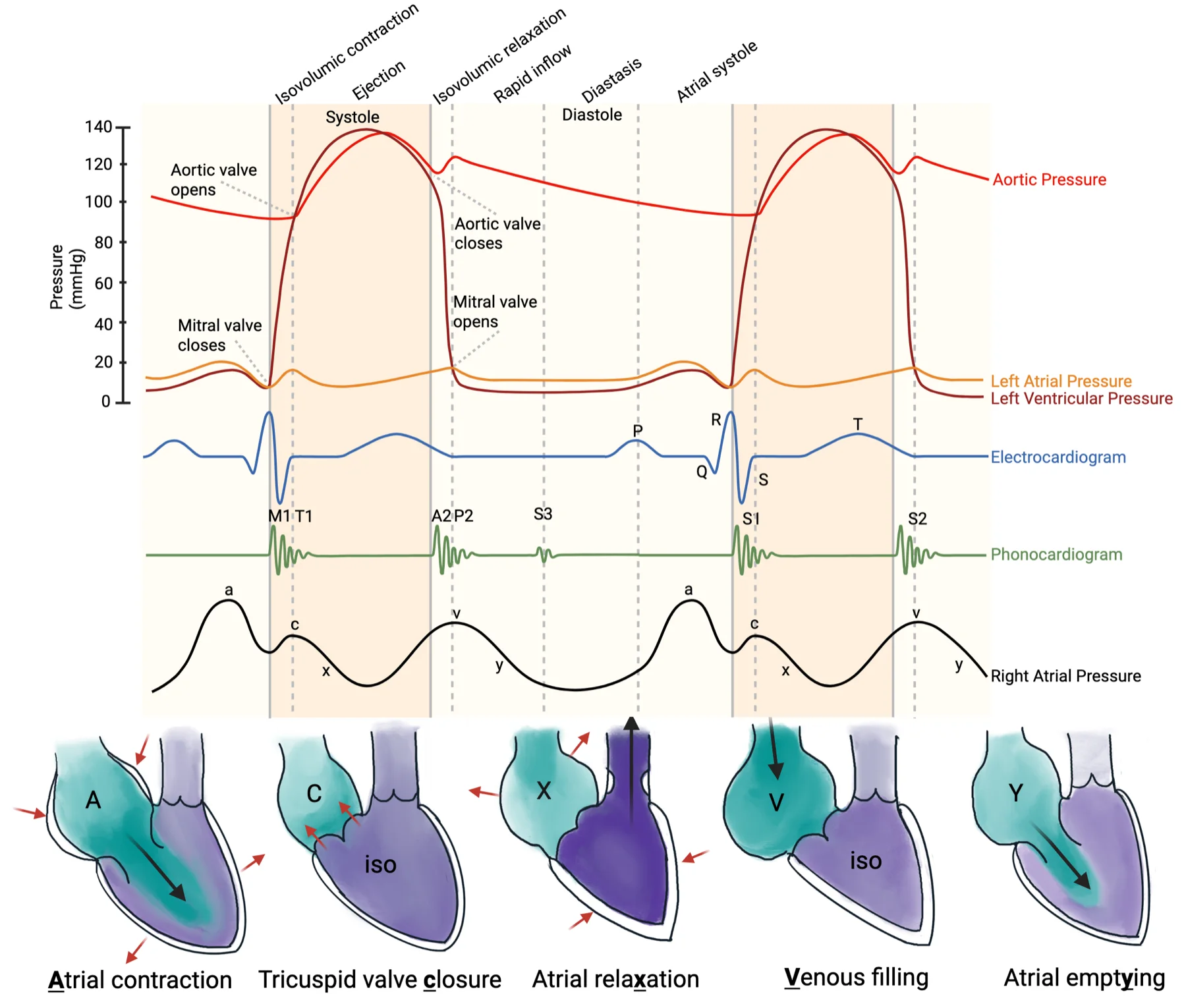
A practical sequence for reading any CVP tracing
- Confirm the catheter records an atrial signal, not a ventricular one (diastole is the clue).
- Display the ECG and the pressure on the same time scale.
- Find the v wave first, just after the T wave; then the a wave after the P; then the c at the end of the QRS.
- Identify the x and y descents and decide which is dominant.
- Ask whether the waves recur regularly with similar amplitude.
- Watch several respiratory cycles and read the pressure at end-expiration.
- Integrate with rhythm, exam, echo, and the ventricular tracings.
After Damrongwatanasuk, Shan & Hu Damrongwatanasuk 2026 and Naderi's “find v first” rule Naderi 2024.
Why the shape matters more than the number
A patient in complete heart block can have a normal mean RAP and still show cannon a waves; early tamponade can have a normal mean before the y descent disappears.
Mean CVP correlates poorly with blood volume and with the response to a fluid bolus; consensus guidance advises against using it alone as a fluid target. Marik 2013
Where to read it
Two separate decisions, not one fixed point on the tracing
1. Cardiac-cycle timing: mean or end-diastolic?
- Mean: the average over the whole cardiac cycle. It includes the v wave, so it is not read at any single point. Baratto 2023
- End-diastolic: mid-a wave in sinus rhythm; in AF, mid-c or just before the v wave. It is a good surrogate for LVEDP, though imprecise (limits about ±11 mmHg during exercise). Baratto 2023
- Tall v waves lift the mean above the end-diastolic value and above LVEDP.
- App convention: PVR is defined from mean pressures, so Swanology uses the mean PAWP for PVR and PH classification and the end-diastolic wedge as the LVEDP surrogate.
2. Respiratory timing: end-expiration or a breath average?
- End-expiration is the usual choice in US centres; ERS recommends averaging over the respiratory cycle when swings are large. The two can differ substantially (during exercise the median peak mean PAWP was 33 versus 26 mmHg). Baratto 2023
- Spontaneous breathing: end-expiration is the top of the swing; on a ventilator it is the low point. In forced expiration (for example COPD) read early in expiration. Bootsma 2022Kern 2022
- In AF, average several beats whichever respiratory convention you use.
- Respiratory timing never replaces the cardiac-cycle choice, and the reverse. Pick each deliberately and say which you used.
Try it: the or the Pitfalls station on the same idea.