
Education only · Residents, fellows, NPs & PAs
Learn to read the Swan, not just the numbers.
A hands-on course in right heart catheterization and CVP waveform interpretation. Every derived value shows its formula, every interpretation shows the rule and the citation behind it, and every waveform is drawn live so you can change the physiology and watch the tracing respond.
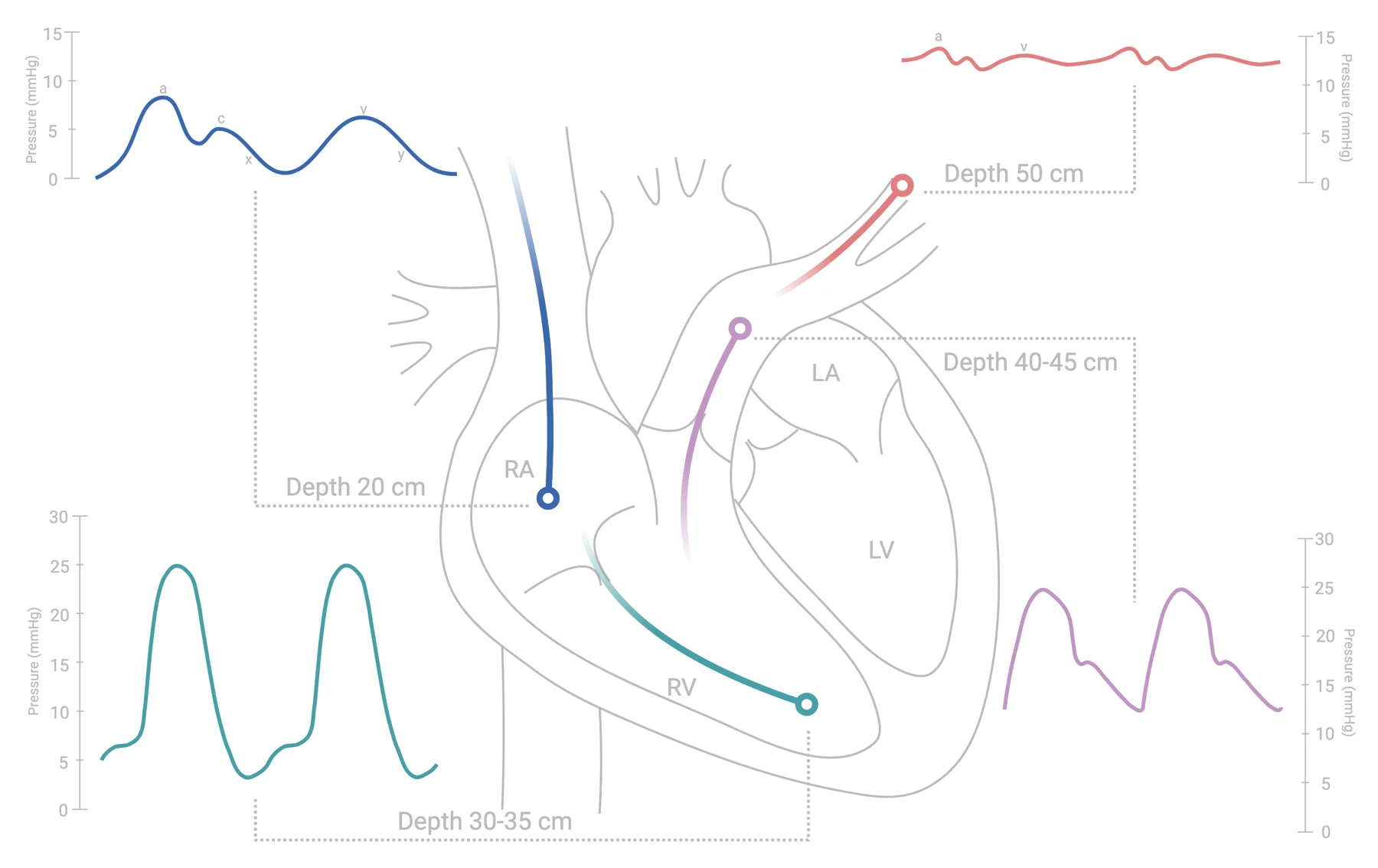
Original figure by Damrongwatanasuk, Shan, and Hu (manuscript in review).
Modules
Work through them in order, or jump to what you need.
- 01
Read the numbers
Enter an RHC and watch every derived value appear with its formula, a data-quality check, and a transparent interpretation that shows which rule fired and why.
Open → - 02
CVP waveform lab
Interactive right-atrial tracings with a linked ECG. Toggle tricuspid disease, constriction, tamponade, arrhythmias; then test yourself on wave identification.
Open → - 03
Swan journey
Advance a pulmonary artery catheter from the right atrium to the wedge and see the waveform change at each landmark, with troubleshooting when it doesn't.
Open → - 04
Measurement pitfalls
Zeroing, leveling, damping, catheter whip, respiration, over-wedging. Hands-on mini-exercises rather than paragraphs.
Open → - 05
Congestion tracker
Plot a patient's trajectory on the RAP–PCWP plane through diuresis, inotropes, or mechanical support.
Open → - 06
Provocation & PH
Vasodilator challenge, exercise, and fluid challenge: what changes, which thresholds apply, and when not to do it.
Open → - 07
Cases
Archetype-based practice with randomized numbers. Commit to an interpretation, then compare with the engine's.
Open → - 08
Sources & rules
Every reference range and every rule in the interpretation engine, with citations and the places where authors disagree.
Open →
Transparent by design
No black boxes. The interpretation engine is a versioned rule table you can read on the Sources page, each rule with its threshold and citation.
Where the sources disagree, we say so
Normal ranges and cutoffs differ between textbooks and guideline years. Swanology shows the competing values rather than picking one silently.